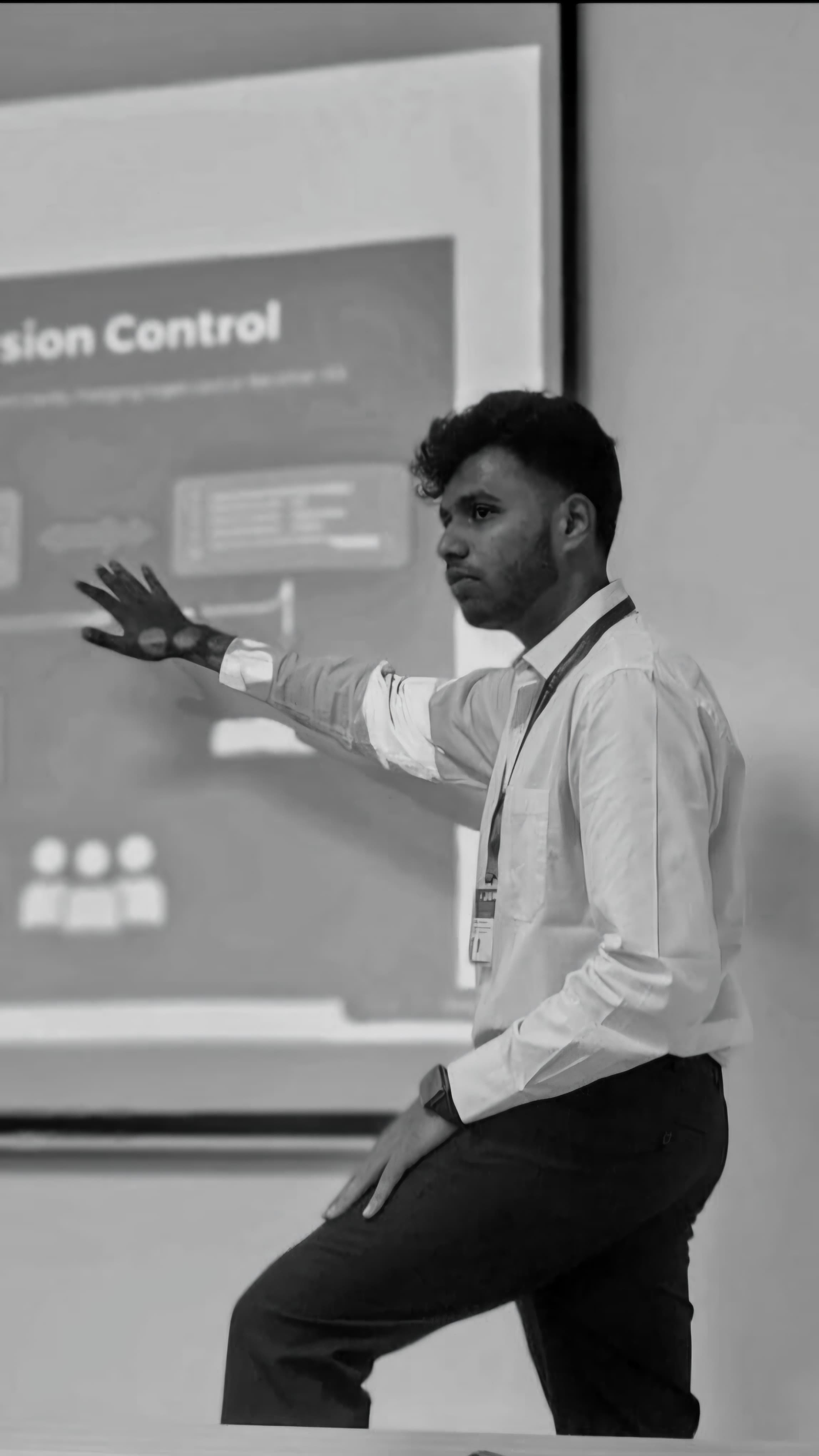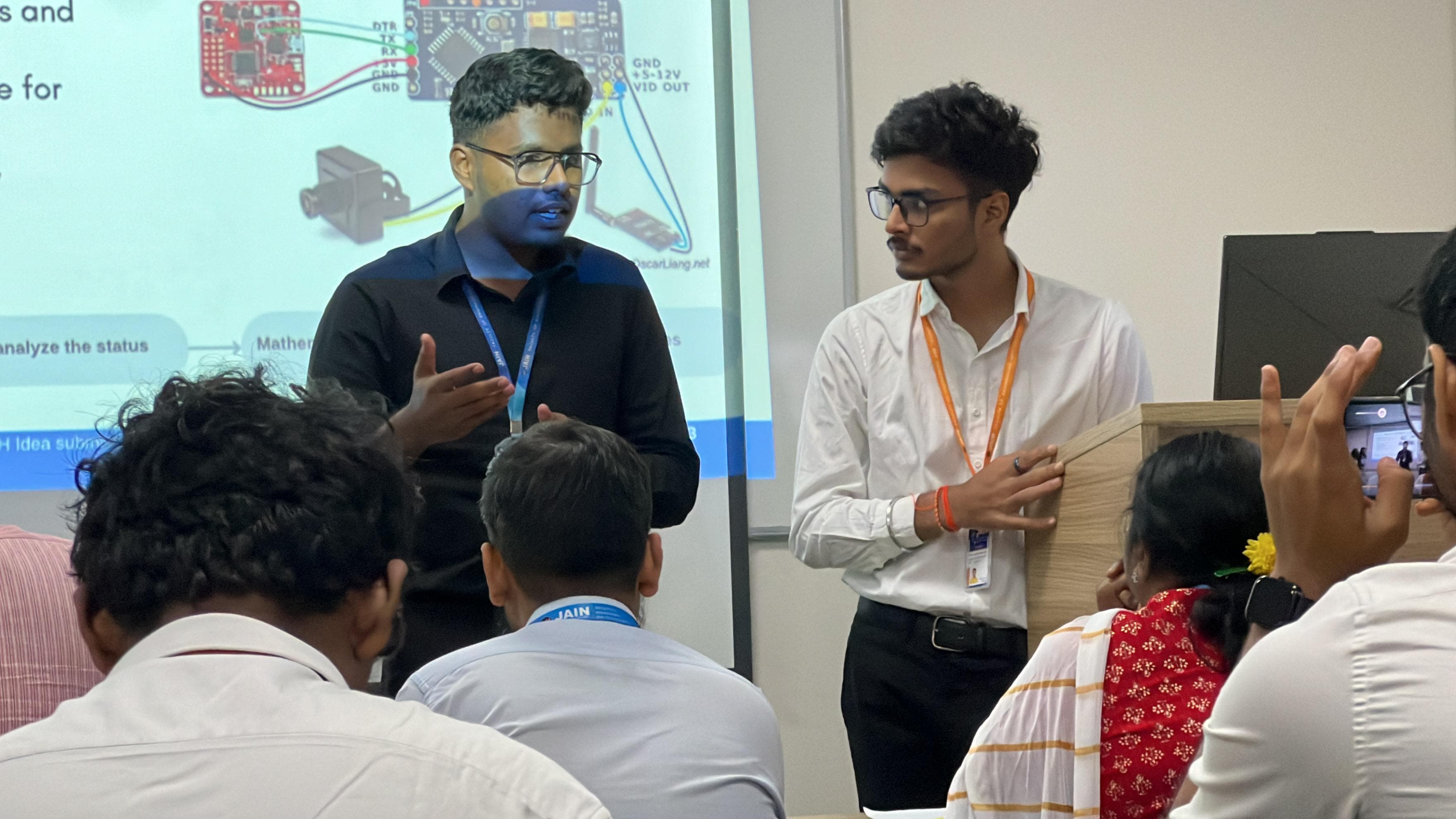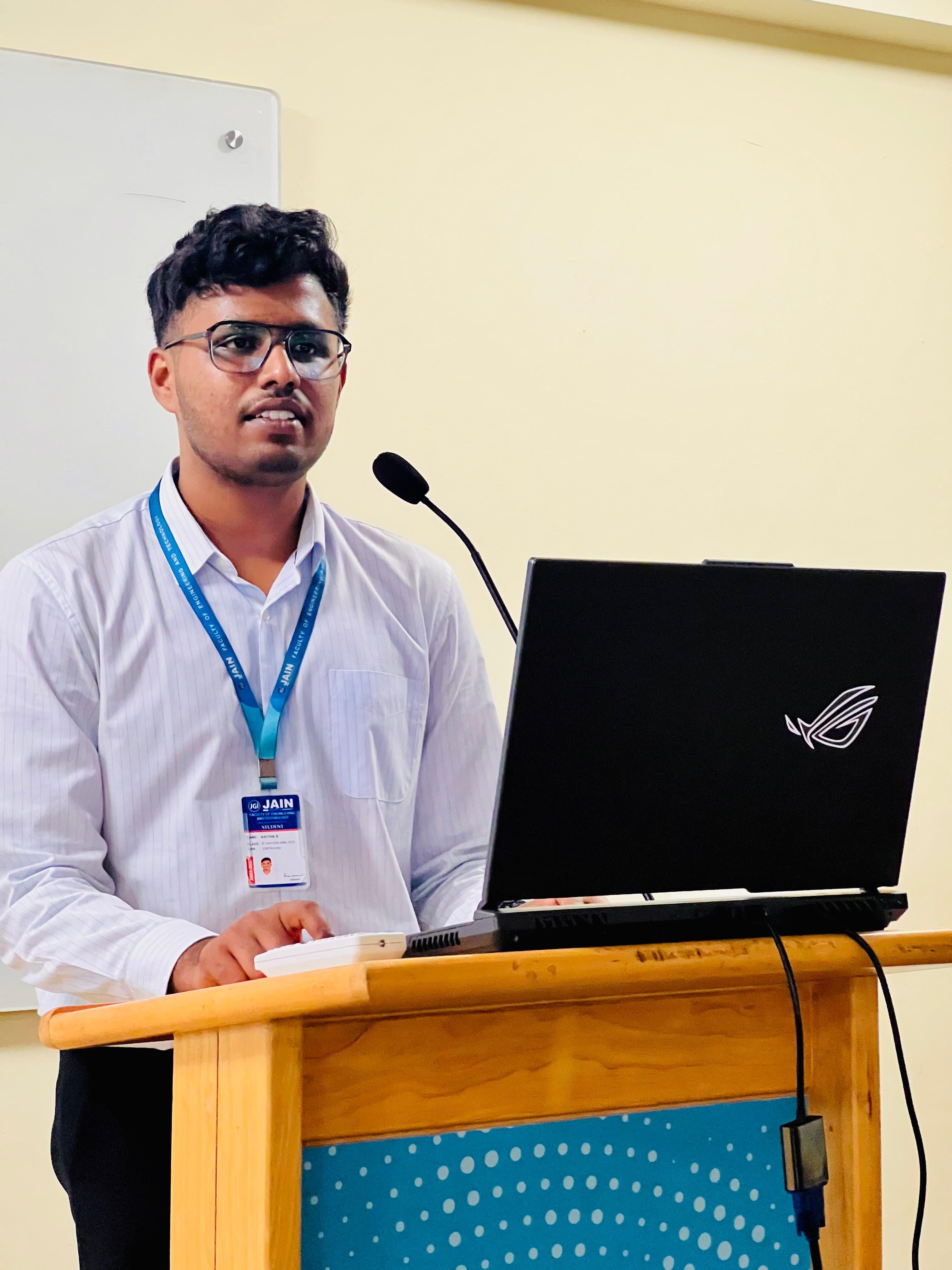





KRITHIK R

KRITHIK R — AI Engineer

Engineering intelligent systems.
Original research.
Real-world execution.

“I build practical AI systems across retrieval-augmented generation, multimodal AI, computer vision, and machine-learning infrastructure.”

Pursuing B.Tech in CSE (AI & ML) at Jain University. Developing open-source Python libraries, researching the Golden Pattern Algorithm, and delivering production systems.

Ventures, Leadership & Affiliations

Business Impact

₹2.8L+

Client sales generated within 36 hours

Student Reach

400+

Students empowered across workshops & tech initiatives

Software Adoption

800+

Learners engaged across deployed educational tools

Production Systems

4+

Autonomous threat engines, BI systems, ambient AI

Featured Engineering

Five production AI architectures & engineered systems.

A curated selection of five verified systems spanning retrieval-augmented generation, multimodal accessibility, model evaluation, computer vision, and pipeline orchestration.

01Retrieval-Augmented Generation
Verified Live Application

Ask OLake

AI Technical Documentation Assistant & RAG Engine

An AI-powered technical documentation assistant using retrieval-augmented generation and hybrid retrieval to support source-grounded answers.

Core Architecture

Dual hybrid retrieval combining dense vector similarity with sparse BM25 lexical keyword ranking.

Execution Pipeline

Reciprocal Rank Fusion (RRF) algorithm to calibrate multi-source retrieval scores without manual tuning.

FAISSBM25Reciprocal Rank FusionFastAPINext.jsPython
Technical Showcase
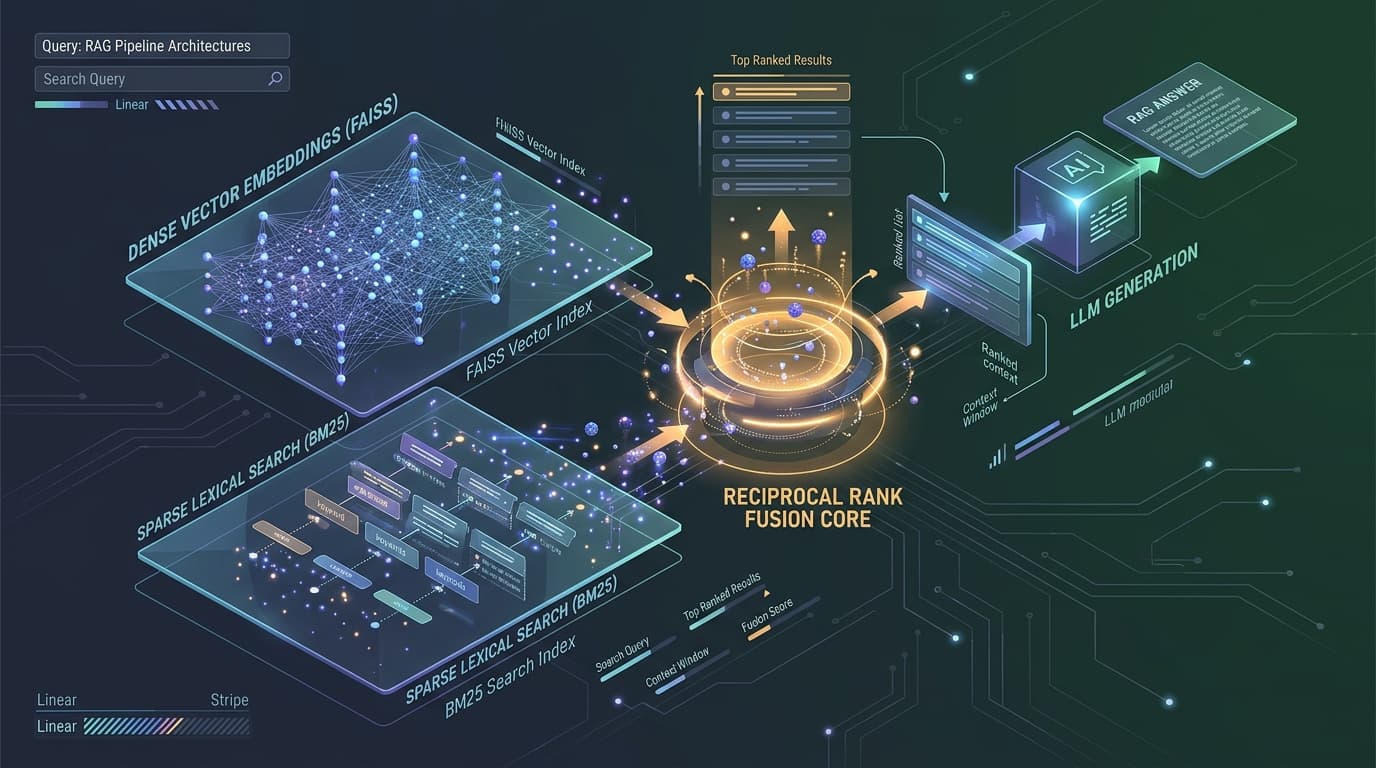
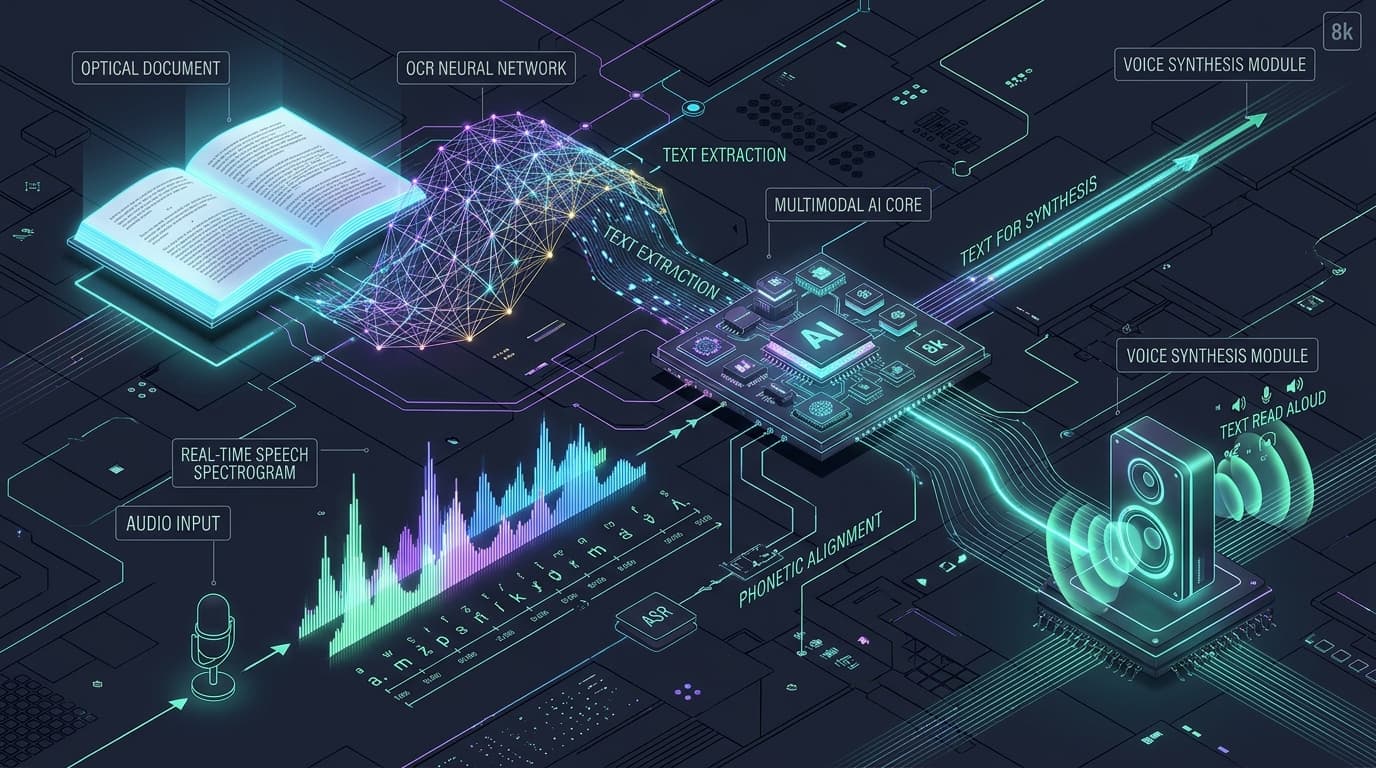
Ask OLake technical architecture illustration
Verified Systems ArchitectureClick 'Interactive' for live demo
02Multimodal Accessibility & Perception
Open Source Prototype

MINDPIECE

Multimodal Learning-Accessibility Prototype

A multimodal learning-accessibility prototype combining OCR, speech recognition, text analysis, and text-to-speech.

Core Architecture

Handwriting image extraction via EasyOCR for student worksheet text parsing.

Execution Pipeline

Speech-to-text reading fluency assessment powered by OpenAI Whisper.

PythonEasyOCRWhisperLevenshtein distanceCoqui TTSFastAPI
Technical Showcase
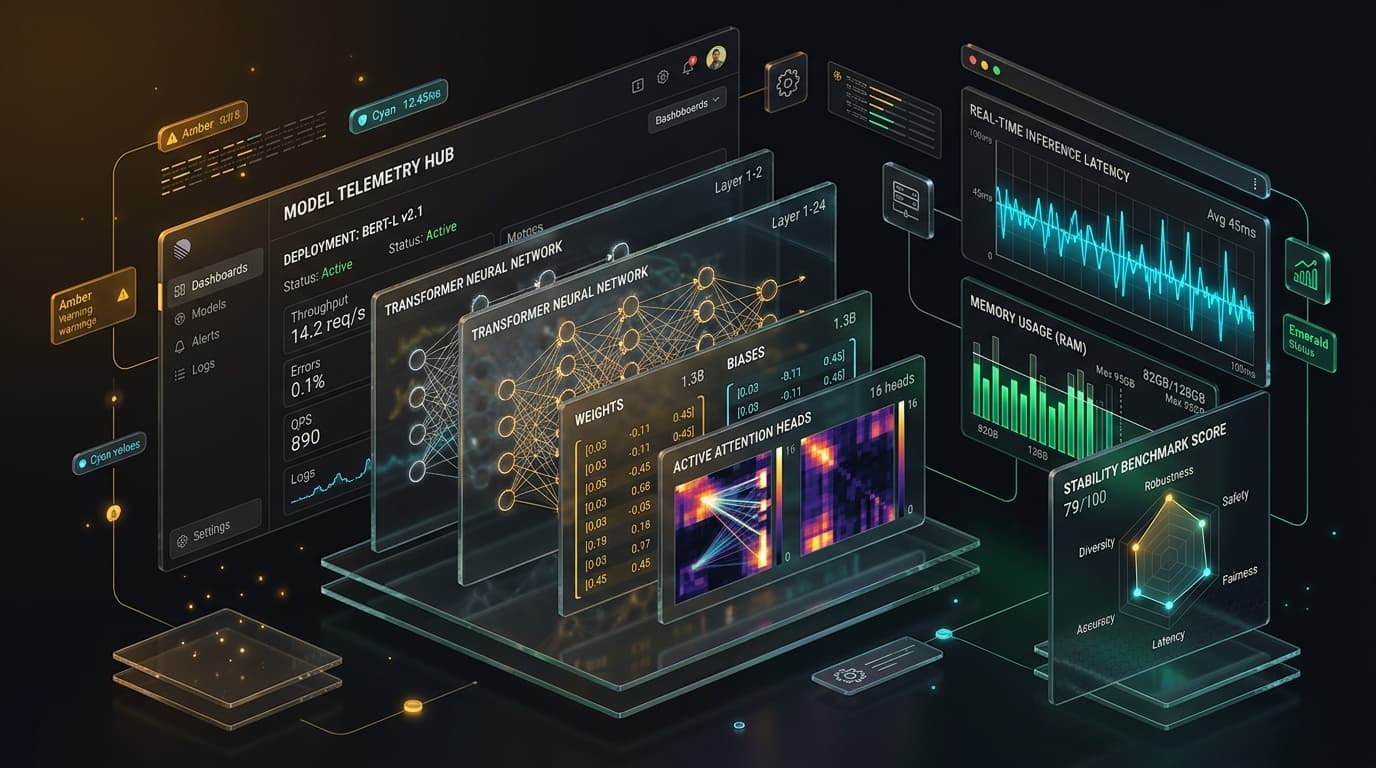
MINDPIECE technical architecture illustration
Verified Systems ArchitectureClick 'Interactive' for live demo
03Model Evaluation & Profiling
Benchmarking Tool & GUI

Hugging Face Model Diagnoser

Model Inspection & Benchmarking Utility

A model-inspection and benchmarking utility designed to analyse computational characteristics such as inference latency, memory usage, throughput, and model size.

Core Architecture

Comprehensive parameter profiling: total trainable parameters, disk weight size, and parameter-to-latency efficiency ratios.

Execution Pipeline

Inference time complexity profiling: mean processing latency, variance distribution, and token throughput per second.

PythonHugging Face TransformersPyTorchTkinterMatplotlib
Technical Showcase
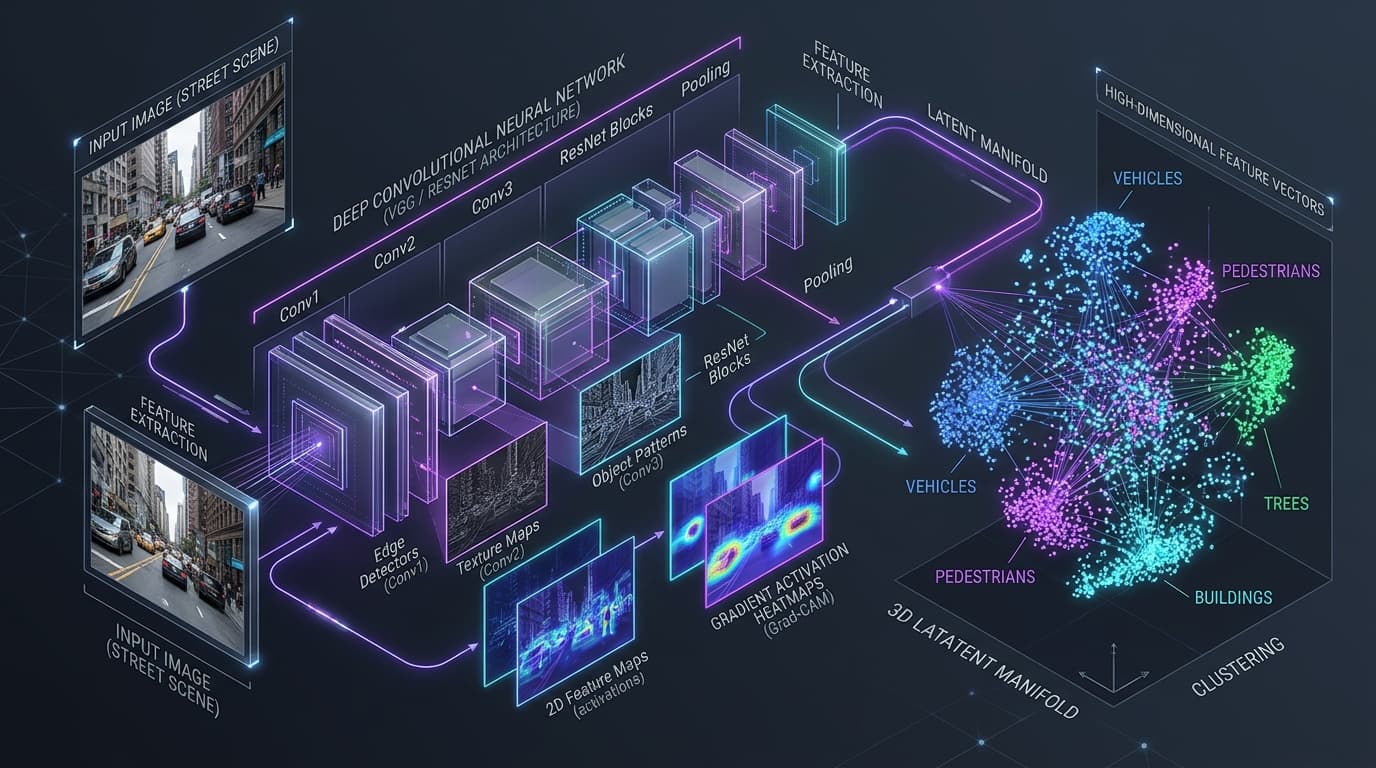
Hugging Face Model Diagnoser technical architecture illustration
Verified Systems ArchitectureClick 'Interactive' for live demo
04Computer Vision & Deep Learning
Research & Implementation Notebooks

Image Feature Extraction

Pretrained Feature Learning & Dimensionality Reduction

A computer-vision project exploring pretrained CNN feature extraction, downstream classification, dimensionality reduction, and image reconstruction.

Core Architecture

Transfer learning feature extraction leveraging pretrained VGG16, ResNet50, InceptionV3, and custom CNNs.

Execution Pipeline

Autoencoder neural architectures for image reconstruction and latent feature interpolation.

TensorFlowKerasVGG16ResNet50Autoencodersscikit-learn
Technical Showcase
Image Feature Extraction technical architecture illustration
Verified Systems ArchitectureClick 'Interactive' for live demo
05AI Infrastructure & Orchestration
Published PyPI Package

Pipeline Connector

Reusable Python Pipeline-Orchestration Library

A reusable Python pipeline-orchestration library intended to simplify multi-stage processing through validation, typed interfaces, asynchronous execution, and error handling.

Core Architecture

Declarative multi-pipeline composition connecting arbitrary data source, processor, and sink nodes.

Execution Pipeline

Native Python asyncio execution engine delivering non-blocking data routing between pipeline stages.

PythonAsyncioPydanticType AnnotationsPyPI
Technical Showcase
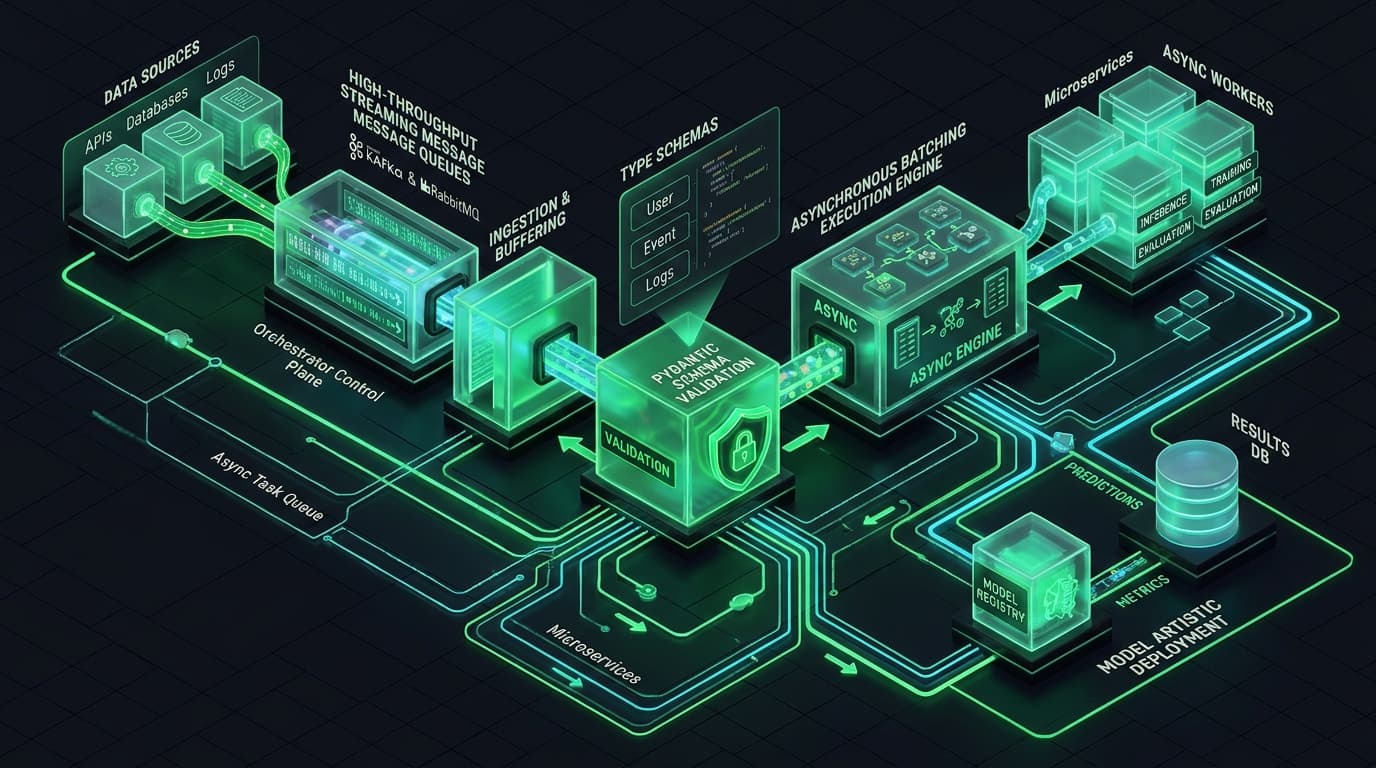
Pipeline Connector technical architecture illustration
Verified Systems ArchitectureClick 'Interactive' for live demo
Explore the complete project catalogue

Browse all 12 verified AI systems, research prototypes, Python libraries, and utilities with full category filtering and keyword search.

View All Projects

Introduction & Philosophy

Bridging the gap between emerging AI capabilities and useful, reliable products.

I am KRITHIK R., Founder, Author, and AI Engineer pursuing a B.Tech in Computer Science and Engineering with a specialization in Artificial Intelligence and Machine Learning.

My work spans agentic AI, generative AI, large language models, retrieval-augmented generation, transformer architectures, multimodal AI, machine learning systems, and cloud infrastructure. I am interested in the complete lifecycle of intelligent systems—from problem formulation and model orchestration to software engineering, testing, deployment, and real-world application.

Beyond implementing existing techniques, I develop open-source Python libraries, explore original algorithmic approaches, work on research-driven projects, and build products that solve practical problems.

I have also built ventures, contributed to student-focused technology initiatives, and generated measurable business outcomes through execution. My broader objective is to bridge the gap between emerging AI capabilities and useful products that create tangible impact.

Core Engineering Philosophy

“Understand the problem deeply, build thoughtfully, and make the result useful in the real world.”
Krithik R - AI Engineer, Researcher & Founder
KRITHIK // 2026
Founder & AI Engineer•Bengaluru // India

Education & Degree

FET // CSE
Jain (Deemed-to-be University) Faculty of Engineering and Technology

B.Tech in Computer Science and Engineering

Jain (Deemed-to-be University)

Specialization in AI & ML•2023 – 2027

Core Domains

Agentic AILLMs & RAGMultimodal SystemsAssistive AlgorithmsPython LibrariesCloud Infrastructure

Professional Positioning

Centered on AI engineering and applied research, supported by entrepreneurship and measurable commercial execution.

Technical Expertise

Five core competencies across AI engineering, systems, and infrastructure.

A defensible, structured breakdown of competencies tested through software libraries, deployed pipelines, and research models.

AI and Machine Learning

Core statistical learning, neural architectures, and computational evaluation.

  • PyTorch & TensorFlow / Keras deep learning
  • Transformer architectures & self-attention
  • Supervised & unsupervised representation learning
  • Model benchmarking & latency/memory profiling
  • Hyperparameter optimization & experiment tracking
  • Feature engineering & dimensional reduction (PCA, t-SNE)

LLMs and Retrieval Systems

Source-grounded retrieval architectures, vector indexing, and model orchestration.

  • Retrieval-augmented generation (RAG) pipelines
  • Dense vector search (FAISS, NumPy)
  • Sparse keyword retrieval (BM25, lexical scoring)
  • Reciprocal Rank Fusion (RRF) & multi-stage re-ranking
  • Structured prompt engineering & function calling
  • Hallucination mitigation & source attribution bounds

Computer Vision and Multimodal AI

Perception systems, multi-stream ingestion, and sensory signal alignment.

  • Pretrained CNN feature extraction (VGG16, ResNet50)
  • Optical character recognition (EasyOCR)
  • Speech-to-text transcription (OpenAI Whisper)
  • Text-to-speech voice synthesis (Coqui TTS)
  • Autoencoders for image reconstruction & interpolation
  • OpenCV real-time video stream manipulation

Backend and AI Application Engineering

Production APIs, asynchronous execution, and typed interfaces.

  • FastAPI & RESTful AI microservices
  • Next.js, React & TypeScript interfaces
  • Python Asyncio & concurrent pipeline orchestration
  • Pydantic strict schema validation & contract enforcement
  • Streamlit interactive machine-learning dashboards
  • Relational & document data stores (SQLite, PostgreSQL)

Tools and Infrastructure

Deployment primitives, packaging, and disciplined version control.

  • Git, GitHub & open-source workflows
  • PyPI package authoring (pip publishing)
  • Google Cloud Platform (Vertex AI, GKE, BigQuery, GCS)
  • Docker containerization & environment reproducibility
  • Vercel serverless deployment & edge functions
  • Linux environment configuration & shell scripting
Verified Credentials & Specializations
Google Cloud · Deep Learning · Systems Simulation
Google CloudSkill Badge

Develop GenAI Apps with Gemini and Streamlit

Engineered generative AI workflows using Gemini multimodal models, function calling, and interactive Streamlit interfaces.

Gemini 1.5StreamlitMultimodal PromptsModel Orchestration
Deep Learning & NLPSpecialization

Transformer Models and BERT Model

Deep mathematical formulation of self-attention mechanisms, multi-head attention layers, bidirectional encoder representations (BERT), and fine-tuning pipelines.

Self-AttentionBERT ArchitectureFine-TuningEmbeddings
Google CloudCloud Infrastructure

Manage Kubernetes in Google Cloud

Configured containerized application deployments, GKE cluster autoscaling, workload health probes, and cloud networking primitives.

GKEContainer OrchestrationPod AutoscalingCloud Security
Google CloudData Engineering

Store, Process, and Manage Data on Google Cloud

Managed production-grade cloud storage buckets, BigQuery analytics, dataset lifecycle management, and scalable data pipeline configurations.

BigQueryCloud StorageData GovernanceConsole Operations
Walmart USAEngineering Simulation

Advanced Software Engineering Job Simulation

Constructed production data structures, optimized query caching layers, and navigated complex distributed system requirements under enterprise constraints.

Data StructuresQuery CachingSystem DesignEnterprise Verification

Open Source & Reusable Software

Three Python libraries published on PyPI.

Reusable software engineering work designed to address automated testing completion, multimodal validation, and decoupled pipeline connections.

Automated Testing & Analytics/PyPI Verified

Krix's Test for Complete Completion

pip install krixs-test-for-complet-complaition
pip install ready

Problem Addressed

Automated testing suites frequently lack granular heuristics to evaluate whether an execution cycle achieved true semantic completion or merely passed surface-level assertions without edge-case coverage.

Main Capabilities

  • Calculates systematic test completion metrics across test execution cycles.
  • Identifies unreached execution branches and subtle silent test failures.
  • Integrates as a lightweight verification hook inside standard Python test harnesses.
Role in Engineering Stack: Engineered to reinforce disciplined verification pipelines across ML model integration testing and backend system assertions.
Multimodal AI Data Validation/PyPI Verified

ModalityCheck

pip install modalitycheck
pip install ready

Problem Addressed

Multimodal AI pipelines handling disparate input streams (audio, image, text, telemetry) frequently break at ingestion boundaries due to tensor shape mismatches, missing modalities, or unaligned token timestamps.

Main Capabilities

  • Validates heterogeneous input streams across multimodal inference pipelines.
  • Enforces schema consistency, tensor dimension checks, and missing modality fallback handling.
  • Lightweight, zero-bloat validation primitives that prevent runtime pipeline crashes.
Role in Engineering Stack: Acts as a foundational pre-flight guardrail before feeding multi-stream inputs into vision-language and speech-text models.
AI Pipeline Orchestration/PyPI Verified

Pipeline Connector

pip install pipeline-connector
pip install ready

Problem Addressed

Connecting disparate data ingestion hooks, feature transformers, and model inference components often requires repetitive glue code with fragile intermediate state passing.

Main Capabilities

  • Standardizes typed connectors between discrete pipeline stages.
  • Maintains clean state contracts and structured error propagation across multi-step flows.
  • Supports composable chaining for modular AI and data processing workflows.
Role in Engineering Stack: Serves as the architectural glue for assembling decoupled, reproducible AI workflows from raw ingestion to model delivery.

Research & Innovation

Original algorithmic exploration and technical investigation.

Investigating novel algorithmic formulations for assistive intelligence alongside research manuscripts on autonomous architectures and edge systems.

Active Research & Algorithmic Development

Golden Pattern Algorithm

Original Research & Algorithmic Innovation for Assistive Accessibility

R&D Notice: R&D Notice: The Golden Pattern Algorithm is an ongoing engineering and assistive research effort. It is not a clinical medical diagnostic tool and does not claim validated clinical diagnosis or therapeutic certification.
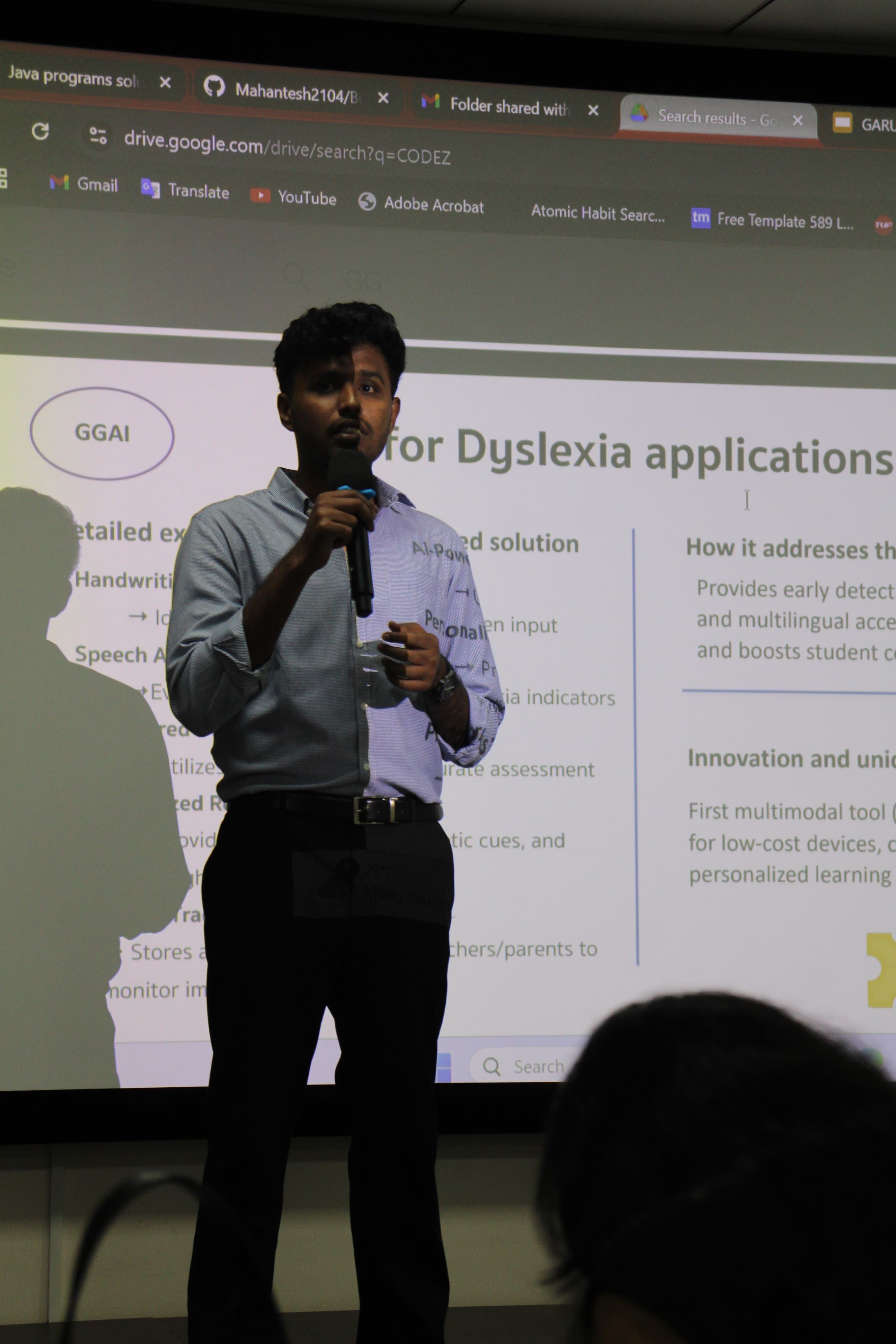
Krithik R defending Golden Pattern Algorithm research for dyslexia applications
R&D // DEFENSE
Live Research Defense•Dyslexia Pattern Screener
01. Problem ExploredCognitive Frictions

Individual variability: Dyslexia presents with significant variation across cognitive, visual, auditory, and motor processing dimensions. Traditional tools apply one-size-fits-all text formatters that fail to adapt to an individual's real-time cognitive pacing and unique processing bottlenecks.

02. Multimodal ApproachSignal Alignment

Multimodal audio & gaze: The algorithm formulates assistive adaptation as a multimodal signal alignment problem. Rather than treating interaction as isolated reading, it harmonizes signals across speech pacing, text comprehension cues, and motor patterns to infer ergonomic cognitive load.

03. The 14 ModesCadence Levers

14 distinct cognitive modes: The framework is architected around 14 fine-tuned operational modes. Spanning auditory-verbal rhythm calibration, visual layout deformation resistance, and motor-tactile cadence tracking, these modes provide granular levers for tailoring interface profiles.

04. Calibration InterviewZero Friction

Non-invasive interview: A concise, non-invasive calibration interview dynamically gathers initial user preferences, sensory friction points, and task contexts to construct a calibrated profile vector, initializing individualized coping mechanisms without cognitive friction.

05. Accessibility AppReal-time Pacing

Ambient software layer: The intended application is an unobtrusive, ambient software layer that dynamically recalibrates educational and reading software in real time—adapting typography, auditory pacing, and visual contrast to support sustained focus and comprehension.

06. Current R&D StatusActive Prototyping

Controlled test scenarios: Currently in active algorithmic formulation and computational prototyping. Core mathematical formulations and multimodal signal connectors are evaluated in controlled experimental settings.

Research Manuscripts & Investigations

MS-01Shared Manuscript

Applied AI Research: Autonomous Architectures & Decision Systems

Autonomous architectures: Explores system architecture, structured reasoning bounds, and operational feedback loops in modern applied artificial intelligence implementations.

Autonomous systemsModel orchestrationOperational telemetry
MS-02Shared Manuscript

Multimodal Perception & Edge Intelligence Systems

Perception architectures: Investigates multimodal signal ingestion, latency envelopes, and perception architectures for real-time edge and ambient environments.

Multimodal processingEdge inferenceSensor fusion
MS-03In Preparation

Original Algorithmic & AI Systems Investigation

Novel algorithmic workflows: Ongoing research investigating novel algorithmic workflows and assistive intelligence. Publication metadata will be indexed upon completion.

Algorithmic researchAssistive systemsAdaptive workflows
Manuscript in Preparation

Student-Focused Applications

Engineering tools to guide learners from concept to production-grade architecture.

Developed to eliminate tutorial paralysis and provide actionable, structured guidance across software architecture and personalized technical learning.

Applied Educational Platform/Target: Students & Aspiring Engineers

Project-Building Guidance

Bridging the gap between conceptual tutorials and production software architecture.

A student-oriented application designed to guide learners through the entire software engineering lifecycle—from initial problem formulation to production-grade implementation and architectural documentation.

Engineered Capabilities:

  • Systematic project structure and layered architecture design guidance.
  • Required technical documentation generation (PRDs, architecture diagrams, schema manifests).
  • Task breakdown engine: decomposing ambiguous concepts into manageable implementation milestones.
  • Technical implementation requirement analysis and component cohesion validation.
Active Educational Utility Production Spec
Career Intelligence & Learning System/Target: Students & Transitioning Engineers

Personalized Career and Learning Pathways

Connecting career exploration with practical, structured learning roadmaps.

A structured guidance application designed to help learners discover fitting career trajectories and follow personalized, actionable learning journeys.

Engineered Capabilities:

  • Personality- and preference-aligned career direction exploration.
  • Curated learning pathways mapped to specific engineering specializations.
  • High-signal resource recommendations: vetted tutorials, key papers, and milestone projects.
  • Execution tracking to encourage real code development over passive tutorial consumption.
Active Educational Utility Production Spec

Entrepreneurship & Commercial Execution

Two ventures bridging technical depth with business momentum.

Taking engineering beyond experimentation: building real client systems, digital products, and sustainable business architectures.

Active Venture

CEO & Founder · Tech & Branding Studio

Apex One Studios logo

Apex One Studios

A technology, engineering, and branding venture focused on building high-stakes software architectures, autonomous AI workflows, and digital products for founders and enterprise clients.

Key Execution Milestones:

  • Engineered end-to-end client systems spanning business intelligence, full-stack web applications, and AI integrations.
  • Delivered high-velocity product execution with disciplined code quality and cinematic brand aesthetics.
  • Generated ₹2.8 lakh+ in client sales within 36 hours for an enterprise client engagement.
  • Leading company vision, operations, client partnerships, and scalable software systems.
Product Development

Consumer-Facing Product Venture

CRAVE product brand

CRAVE

A consumer-oriented product venture exploring modern digital interaction, user engagement loops, and intuitive mobile/web product surfaces.

Key Execution Milestones:

  • Designed user-centric consumer experience emphasizing visual appeal, responsiveness, and minimal friction.
  • Architected backend integration pipelines to support real-time interactions.
  • Focused on translating consumer intent into immediate product utility.

Impact & Community Leadership

Measurable commercial outcomes and student empowerment.

Validated Commercial Achievement•
Apex One Studios

₹2.8 lakh+

in client sales within 36 hours

Engineered through high-velocity product execution, targeted conversion architecture, and decisive technical execution for a client campaign.

Krithik R conducting technical workshop for students
IMPACT // 500+
500+ Students Mentored•Hands-on AI Workshop
Community Leadership

400+

Students Reached in Technical Workshops 15+ bootcamps

Technology Initiatives & Practical Workshops

Conducted technology initiatives and technical workshops reaching 400+ students. The core mission is equipping learners to master practical project building, discover individual engineering strengths, build production-grade portfolios, and avoid becoming another overlooked resume in corporate applicant pools.

Organized Across:
The Turing Club
GDSC
GDSC // GDG

800+

Active Educational Users

production adoption

Active Educational Platform Engagement

More than 800 students have actively engaged with deployed student-focused educational tools, guidance platforms, and learning utilities developed across initiatives.

Experience & Background

Career history and organizational leadership.

Hands-on experience managing operations, technical teams, and product delivery across high-velocity ecosystems.

Fellowship // Phase 01

Vice Fellow · Operations & Network Scaling

UNDER 25

Served as Vice Fellow, managing operations and community infrastructure. Connecting students with opportunities, founder-level execution, organic network scaling, and ecosystem growth.

Dec 2024 – Jan 2025 // Phase 02

QA Tester & Product Marketing Intern

Collective Artists Network

Bridged software quality assurance testing with product marketing systems, validating production features and engineering scalable workflows under commercial constraints.

Sep 2023 – Present · 3+ Years // Phase 03
The Turing Club FET-JAIN

Operations, Design & Engineering Leadership

The Turing Club (TTC)

3+ year leadership progression across 4 pivotal roles: Mentor (Sep 2026 – Present), Chief of Operations and Relations (Sep 2025 – Sep 2026), Outreach Lead & Senior Graphic Designer (Oct 2024 – Sep 2025), and Graphic Designer (Sep 2023 – Oct 2024).

Leadership Progression:

  • Mentor (Sep 2026 – Present): Mentoring members in technical projects, problem-solving, and collaborative growth.
  • Chief of Operations & Relations (Sep 2025 – Sep 2026): Managing strategic partnerships, internal workflows, and institutional engagements.
  • Outreach Lead & Senior Graphic Designer (Oct 2024 – Sep 2025): Directing student outreach campaigns and brand design.
  • Graphic Designer (Sep 2023 – Oct 2024): Visual assets, event identities, and digital collateral.
Jan 2025 – Present // Phase 04
Apex One Studios & Independent R&D logo

CEO & Founder · AI Ecosystem & Ventures

Apex One Studios & Independent R&D

Leading company vision, operations, and technical strategy at Apex One Studios (₹2.8L+ client revenue in 36h). Developing autonomous threat engines, Python libraries, and assistive research.

Apr 2024 – Present · 2+ Years // Community
Google Developer Student Clubs
GDSC // GDG

Active Contributor & Campus Outreach Lead

GDSC - FET Jain University & GDG Bangalore

Active contributor at Google Developer Student Clubs (GDSC) - FET Jain University and GDG Bangalore. Also serving as Outreach Lead at Celluloid Club, connecting students with innovation, technical workshops, and industry exposure.

Architectural Decisions

Three case studies on making hard systems behave with discipline.

Case Study 01

Architecting for Signal

System Flow

ingest
reason
decide
feedback

Problem

Complex systems often fail because the operator sees too much and understands too little.

Architecture

Layered interfaces: ingestion, reasoning, decision surface, and operator feedback.

Decisions

Favor composable primitives, fast instrumentation, and visible state transitions.

Constraints

Latency, incomplete data, ambiguous user intent, and the cost of false confidence.

Key Engineering Lesson

“A system becomes elite when it knows what not to show.”

Case Study 02

Security Without Theater

System Flow

observe
score
contain
recover

Problem

Most security interfaces reward panic instead of calm, disciplined judgment.

Architecture

Threat graph, policy engine, model-assisted triage, and containment timeline.

Decisions

Make severity explainable and make every alert earn its space.

Constraints

Adversarial noise, brittle heuristics, and trust boundaries around model output.

Key Engineering Lesson

“Calm interfaces make dangerous systems usable.”

Case Study 03

Ambient AI as Infrastructure

System Flow

sense
interpret
act
learn

Problem

AI assistants feel detached when they ignore physical environment, hardware, and user rhythm.

Architecture

Sensor context, intent layer, action router, memory, and graceful fallback states.

Decisions

Keep interaction subtle, inspectable, and reversible.

Constraints

Privacy, local reliability, device diversity, and failure transparency.

Key Engineering Lesson

“The best interface sometimes feels like the room becoming smarter.”

Direct Channels

Let's build intelligent systems together.

Open for selective AI engineering collaborations, research initiatives, Python library contributions, and venture discussions.

Typically responds within 24 hours